Commercial Cleaning Contractors
Commercial Cleaning Contractors buy floor machines as working capital, not fixtures. The machine has to survive multiple operators across multiple sites, keep earning through the life of a contract that may not be renewed, and be repairable locally without a crew standing idle waiting on an imported part.
Find Distributor
A contractor does not buy a floor machine the way a building owner does. The owner buys once for one building and lives with the choice. You buy for a portfolio you do not fully control, on contract terms that can end at short notice, to be operated by people who may have started last week. The purchase price is the least interesting number in the decision. What matters is what the machine costs per hour over its working life, how many hours it loses to being broken, and what it is worth on the day a contract goes elsewhere.
POLIVAC has manufactured in Kensington, Melbourne since 1949 and has been ISO 9001 certified since 1997. That matters here less as heritage than as a supply position: the machines are built in Australia, the parts are held in Australia, and they are sold and serviced through 225+ distributors nationally rather than direct. For a contractor running sites across several states, the practical effect is that the person who quotes the machine is also the person who stocks the consumables and takes the call when it stops.
Standardising a fleet across a portfolio that has nothing in common
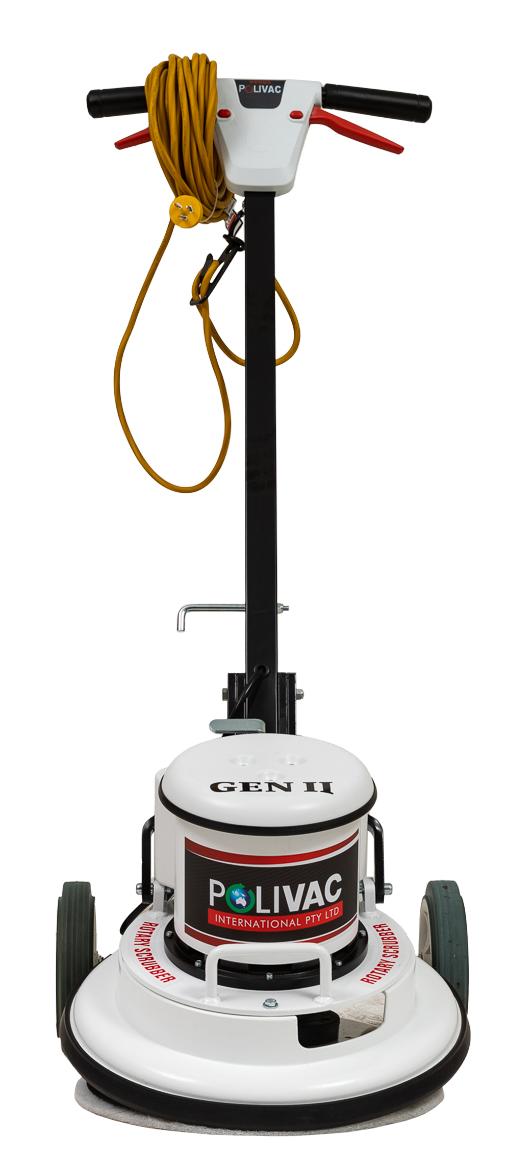
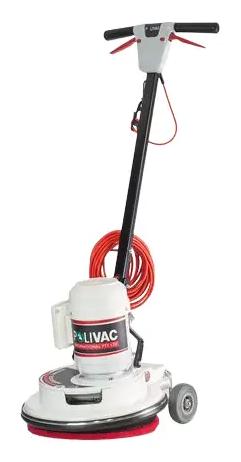
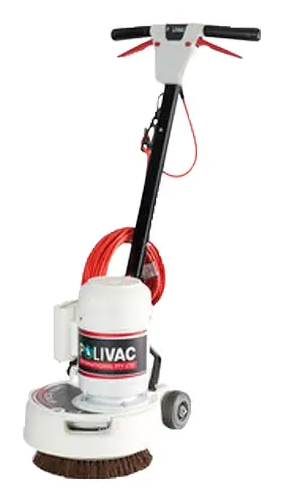
No two sites on a contractor’s book share a floor build-up. One is carpet tile across a whole floor plate, the next is sealed concrete with a loading dock, the next is vinyl in a corridor that cannot be closed. The instinct is to buy the ideal machine for each scope, and the result is a fleet where no two machines share a pad, a bag or a filter. Standardising on a small number of platforms costs a little efficiency at any single site and returns far more in stores, training and swap-outs. A crew that can run a C25 can run a C25 GEN2 or a C25TS without being retrained, and the PV25 suction polishers carry the same operating familiarity while adding dust capture at source where the scope demands it. On the scrubbing side the C27 and C27 GEN2 cover general hard floor, the GB380D battery mini scrubber handles the areas where a lead is a hazard rather than an inconvenience, and the MM1700E automatic scrubber takes the sites where floor area finally justifies it.
Training, turnover and machines that forgive
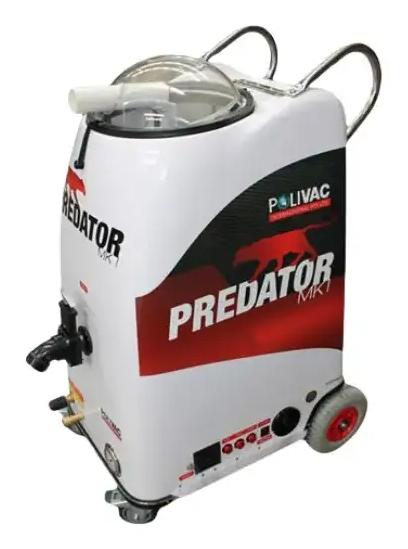
The realistic training window for a new operator is one shift alongside a supervisor, not a course. That rules out equipment where the difference between correct use and floor damage is a matter of judgement. It also argues for keeping one machine type doing one job across the fleet, so a supervisor moving between sites is checking technique rather than diagnosing an unfamiliar unit. Where a scope genuinely needs two behaviours from one machine, a two-speed platform is a safer answer than issuing two machines and hoping the right one gets used. The same logic applies to your carpet work: the Mini Terminator and Predator extractors are chosen by crew and access, not by which one an operator prefers.
Buying through a distributor, and what that changes
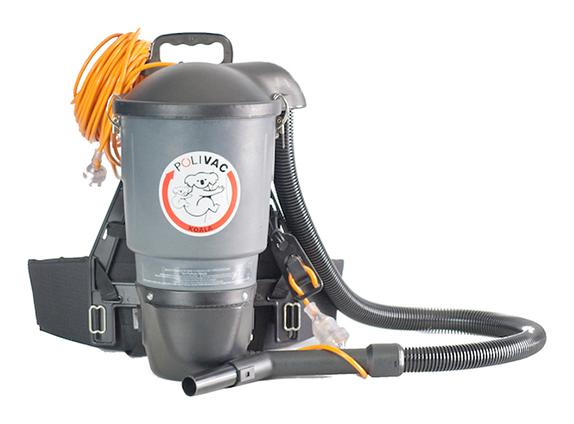
POLIVAC does not sell direct, which is occasionally read as an obstacle and is usually the opposite. Your account sits with a distributor who holds pads, bags, brushes and wear parts locally, who can put a loan machine in front of you rather than quoting a lead time, and who knows the sites in your region. 225+ of them operate across Australia. Where it pays to be deliberate is at the point of specification: bring your actual site mix, your shift pattern and your operator turnover to that conversation rather than a model number, because the fleet that suits a nightly office run is not the fleet that suits a schools contract with a heavy periodic program. Get the platform choice right once and the consumables, the training and the resale all follow from it.
Common questions in commercial cleaning contractors
Ready to spec your site?
Your nearest distributor will walk the site with you and pull the right system together — machines, pads, chemistry and training.