Carpet extractor vs carpet cleaner: what’s the difference and which does your business need?
A carpet cleaner agitates the surface with brushes and tank-fed solution, which suits interim maintenance and encapsulation work. A carpet extractor injects heated solution into the pile under pressure and vacuums it straight back out. For deep cleaning commercial carpet under real foot traffic, extraction is the process that works.
If you manage cleaning for a hotel, hospital, school or commercial facility, the question of carpet extractor vs carpet cleaner will come up sooner or later — and getting it wrong is an expensive mistake. These two terms are often used interchangeably, but they describe meaningfully different machines, built for different jobs, with very different results on carpet.
The short answer: a carpet cleaner uses mechanical agitation and tank-fed water to work the carpet surface, suited to interim maintenance, encapsulation cleaning, and quick-turnaround sites. A carpet extractor forces heated cleaning solution deep into the pile under pressure, then immediately vacuums it back out. The two machines aren’t interchangeable. They serve different stages of carpet care. For deep cleaning in high-traffic commercial environments like hotels, hospitals, schools, shopping centres, and aged care, extraction is the process that matters. Here’s why.
What is a carpet cleaner?
A carpet cleaner — sometimes called a carpet shampooer — is built for surface-level cleaning and interim maintenance. It delivers cleaning solution to the carpet through a gravity-fed tank, uses rotating brushes to agitate the fibres, and either recovers the soiled solution through integrated vacuum suction or relies on evaporation and follow-up vacuuming to finish the job.
Some shampooers also use a carpet bonnet attachment for encapsulation cleaning, a process where a specialised polymer crystallises around soil particles so they can be lifted away with a subsequent vacuum pass.
These machines are lighter, more compact, and often faster on the job than extraction units. They are the right tool for specific applications: interim cleans between deep extractions, encapsulation on synthetic fibres, and sites where rapid return to service or low water use is a hard constraint.
How a carpet cleaner works
A carpet shampooer works by mechanical agitation rather than pressurised water injection. A solution tank feeds cleaning fluid onto the carpet. A rotating brush head works the chemistry into the pile. Depending on the machine, an integrated vacuum recovers the soiled solution, or the carpet is left to dry while the cleaning chemistry suspends the soil for a follow-up vacuum pass.
Encapsulation cleaning works on the same principle but swaps the brush for a bonnet. The bonnet applies a polymer-based solution that crystallises around soil particles as it passes over the fibre. Once the polymer dries, the encapsulated soil is vacuumed away. It is particularly effective on synthetic fibres and in situations where drying time matters more than deep penetration.
When a carpet cleaner is the right choice
- Interim maintenance between deep extractions
- Encapsulation cleaning, particularly on synthetic fibres
- Sites where drying time, water use, or rapid return to service is a hard constraint
- Residential or small-area commercial applications with light soiling
What is a carpet extractor?
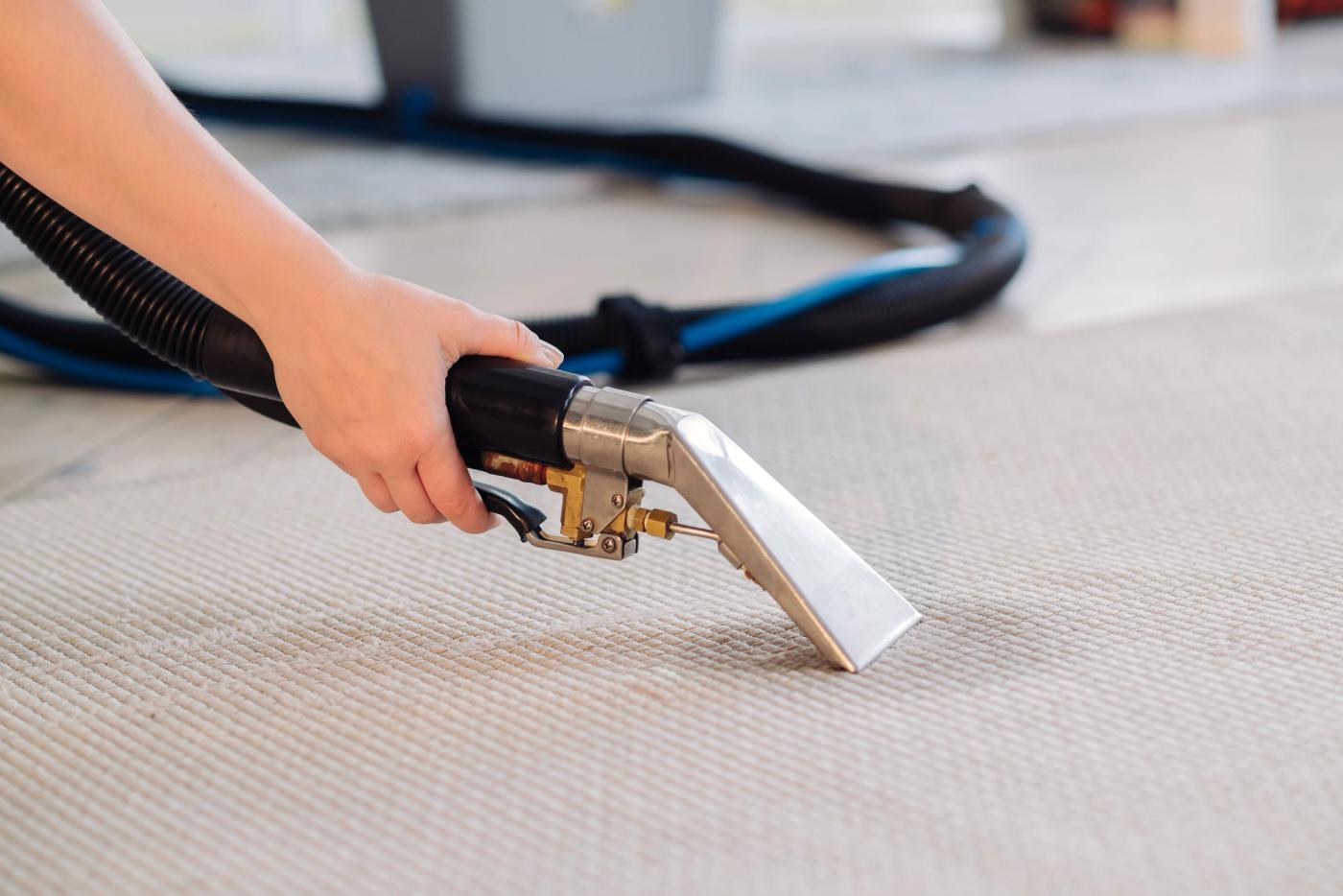
A carpet extractor, also known as a hot water extraction machine — often searched as a “carpet steam cleaner”, though the process isn’t actually steam cleaning — is the industry standard for commercial-grade carpet cleaning. It works by injecting a heated solution of water and cleaning chemicals deep into the carpet pile under pressure, agitating the fibres, and immediately recovering the dirty solution through a powerful vacuum system.
The result: a clean that goes beyond the surface.
Embedded grime, allergens, bacteria, and staining that routine vacuuming leaves behind are removed completely. For commercial facilities where carpets take heavy foot traffic and hygiene standards matter, this level of clean is the baseline.
How a carpet extraction machine works
A commercial carpet extraction machine uses two separate tanks: one for clean solution, one for dirty recovered water. Hot water mixed with a cleaning chemical is injected into the carpet pile under pressure, loosening and dissolving embedded soiling. The wand or cleaning head then agitates the fibres to break down stubborn staining. A high-powered vacuum system, typically twin motors on commercial-grade machines, immediately extracts the dirty solution along with the dislodged soil before it can re-settle into the pile.
The separation of clean and dirty water is critical. It ensures you are never re-depositing dirty water back into the carpet, which is a common issue with simpler, combined-tank machines.
The role of heat and pressure
Temperature plays an essential role in commercial carpet extraction. Heated water dissolves oil, grease, and biological soils far more effectively than cold water. Commercial extractors in the Polivac Predator series carry a temperature control mechanism that holds water temperature up to 70°C, which is useful in hotels, aged care, and food-service environments where biological soiling is routine.
Pressure is equally important, but not in the way marketing sometimes implies. The working pressure required depends on the surface being cleaned. For carpet extraction, 350 to 500 PSI is the operational range. For upholstery, operators dial pressure down to around 150 PSI to protect the fabric. Polivac Predator machines carry pumps rated well above those working figures — the Predator MK1 uses a 2000 PSI pump, factory set to 500 PSI for carpet work. That headroom means the pump runs well within its capability across every application, which extends service life.
Carpet extractor vs carpet cleaner: key differences at a glance
- Cleaning depth: a carpet cleaner works the surface fibres, an extractor works deep into the pile and backing.
- Water delivery: gravity-fed tank with no pressure, against pressurised injection.
- Working pressure: not applicable on a cleaner. On an extractor, 350 to 500 PSI for carpet and around 150 PSI for upholstery.
- Pump capacity: not applicable on a cleaner. Up to 2000 PSI on an extractor such as the Predator MK1.
- Motor configuration: single, low-wattage motor on a cleaner. Twin 1,100W motors on commercial extraction units.
- Tank size: under 10 litres on a cleaner. 50 litres standard on an extractor, up to 100 litres on high-capacity variants.
- Drying time: variable on a cleaner and slow if the carpet is oversaturated. Faster on an extractor, driven by suction power.
- Soiling suited to: light to moderate interim work, against moderate to heavy deep cleaning.
- Hot water capability: rare on a cleaner, standard on commercial extraction units.
- Allergen and bacteria removal: partial on a cleaner, thorough on an extractor.
Why drying time matters more than you think
Drying time is the factor most buyers overlook when choosing between a carpet cleaner and a carpet extraction machine. In a commercial facility, it has direct operational, hygiene, and safety consequences.
A machine that leaves carpets oversaturated creates a slip hazard. Safe Work Australia’s guidance on slips, trips and falls identifies wet cleaning methods as a common slip risk and recommends that floors be thoroughly dried after cleaning. In a hotel corridor, hospital ward, shopping centre or school hallway, extended drying times translate directly into extended downtime and increased WHS risk.
Another source of mould growth is wet carpet. If the underlay remains damp, then mould grows beneath the carpet surface and becomes an issue that requires replacement, rather than cleaning. Damp carpet fibres will hold on to more dirt than dry carpet fibres will, because dry fibres can release dirt to be collected by your next pass with the vacuum cleaner.
Commercial carpet extractors address all three through raw suction power. Twin vacuum motors, like the suspension-mounted bypass motors in the Polivac Predator series, recover more moisture from the carpet pile than consumer-grade machines. The result is carpets that are damp rather than wet, and ready for foot traffic far sooner.
That alone justifies investing in a proper commercial carpet extraction machine rather than running an underpowered cleaner on jobs it was not designed for.
Choosing the right machine for your facility
Not every commercial setting has identical needs. Here is how to think through the decision.
High-traffic commercial facilities: offices, hotels, shopping centres, aged care
These environments deal with heavy foot traffic, regular soiling from food and beverages, and the ongoing need to maintain appearance and hygiene standards. Carpets in hotels and aged care facilities also face biological soiling, a concern that goes beyond aesthetics into hygiene compliance.
For these settings, a full-powered portable carpet extractor is the baseline. Look for dual-motor vacuum systems, large-capacity tanks, and a thermostatically controlled heater. The Polivac Predator MK1 fits squarely in this category: a 2000 PSI pump factory set to 500 PSI for carpet work, twin 1,100W vacuum motors, and separate 50-litre solution and recovery tanks, meaning it can cover large areas without constant stops to empty and refill.
For larger sites where frequent refilling becomes a productivity drain, the 2nd Generation Predator MK1 high-capacity variant runs 100-litre solution and 45-litre recovery tanks, meaningful extra capacity for large shopping centres, aged care facilities, or commercial office floors.
Operators running long shifts on the largest sites can also specify the optional Auto Fill and Auto Empty fitment, available across the entire Predator range and the Terminator. Auto Fill plugs straight into a tap and keeps the solution tank topped up; Auto Empty pumps the waste tank continuously through a garden hose to a drain. Together they remove the stop-start of refilling and emptying, so a single operator can keep working as long as the contract requires.
Schools and educational facilities
Schools present a specific challenge: large carpeted areas, tight cleaning windows, usually after hours or on weekends, and budget scrutiny from procurement managers. Efficiency matters as much as cleaning performance.
A portable extractor with sufficient hose reach allows one operator to cover substantial floor area without constantly repositioning the machine. The Predator MK1 includes 7.5-metre solution and vacuum hoses, with 15-metre hoses available as an option. Faster coverage and faster drying times help ensure classrooms and corridors are ready when students arrive.
Hospitals and healthcare environments
Of all commercial establishments, healthcare facilities have the highest hygiene standards. Allergens, microorganisms, and pathogens in carpets in reception areas, passageways, and patient rooms pose a serious threat if not properly removed.
Hot water extraction at commercial-grade temperatures delivers higher disinfection performance than surface-only cleaning. Health agency protocols for infection control consistently recommend deep extraction as the appropriate process for carpets in healthcare environments.
For healthcare procurement, machine durability and serviceability matter as much as cleaning performance. Downtime on a cleaning machine in a hospital setting isn’t acceptable. Polivac machines are built in Kensington, Melbourne, with 225+ distributors nationally, which means parts and service support are accessible across Australia, not locked to a single metro depot.
Contract cleaners operating across multiple sites
For contract cleaning businesses, the priorities shift. You need a machine that is both capable and portable: powerful enough to produce professional results at each site, but mobile enough to load in and out of a vehicle daily.
The Polivac Predator range, with pneumatic wheels and easy-grip stainless steel handles, is designed specifically for this kind of operational reality. The Terminator Plus offers a more compact body, easier to manoeuvre into tight spaces and fit into a station wagon, while still delivering 600 PSI pump pressure. For operators who need something lighter again for upholstery and small-area work, the Mini Terminator runs a single 1,200 watt single-stage Ametek vacuum motor at 220 PSI working pressure. It is a different machine to the rest of the range rather than a smaller version of it, and that single-motor configuration is what keeps it portable.
Built in Australia. Backed across Australia.
Polivac has been manufacturing commercial cleaning equipment in Australia since 1949. Over 75 years of engineering machines that perform in Australian conditions, with Australian-made build quality and a service network to match.
Every machine in the Polivac carpet extraction range is designed and built at the Kensington facility in Melbourne. Fibreglass bodies with aluminium frames. Italian-made Annovi Reverberi piston pumps. Suspension-mounted vacuum motors. Those are the engineering choices that explain why operators describe Polivac machines as lasting a decade or more under hard commercial use.
For facility managers and procurement teams, a national distributor network of 225+ dealers is practical reassurance. If a part is needed or a machine requires service, you aren’t waiting on overseas shipment or dealing with a supplier that has one location in Sydney.
The Predator range spans from compact portables through to high-pressure units capable of handling carpet, tile, and grout cleaning with an appropriate spinner attachment. That gives commercial operators versatility across surface types from a single machine investment.
The bottom line
The carpet extractor vs carpet cleaner decision comes down to what the job actually is. For deep cleaning of commercial carpets under real-world foot traffic and soiling, extraction is the process. For interim maintenance, encapsulation, and quick-turn sites, a shampooer does what it needs to do. The two machines serve different stages of the carpet care cycle, not competing products but complementary.
What you don’t want is an underpowered machine trying to do a job it wasn’t designed for. A shampooer on heavy commercial soiling, or a consumer-grade extractor with undersized motors on a shopping centre carpet, leaves the operator behind and the site wet.
If your current machine is leaving carpets wet and your operators behind schedule, the machine isn’t the right one for the job.
Explore the full Polivac carpet extraction machine range, or contact your nearest Polivac distributor for advice on the right model for your sites.
Sources
- Safe Work Australia, Slips and Trips Fact Sheet: safeworkaustralia.gov.au
- Polivac International, Carpet Extraction Machine Range: polivac.com.au/productcat/carpet-extraction-machine/
- Polivac International, About Polivac: polivac.com.au/about/
POLIVAC Predator MK 1 – Carpet ExtractorPOLIVAC 2nd Generation Predator MK1POLIVAC Terminator Plus – Carpet ExtractorPOLIVAC Mini Terminator
Ask a distributor to spec itReviewed 21 August 2026